
Myobrace for Children: What Parents Should Know
Many parents assume that crooked teeth are simply inherited and that orthodontic treatment can only begin once all permanent teeth have erupted. While genetics can influence the size and shape of the jaws, tooth crowding, overbites, underbites and other aspects of dental development, oral habits and environmental factors can also influence how a child’s teeth and jaws develop.
This is where early orthodontic assessment can be helpful.
At Dr M Dental Clinic, we provide Myobrace treatment for children as a pre-orthodontic approach that focuses on dental development, jaw development and oral habits while a child is still growing.
What Is Myobrace?
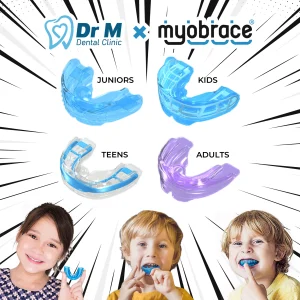
Myobrace is a preventive pre-orthodontic treatment system designed primarily for children. It uses removable intraoral appliances together with exercises that aim to address habits associated with developing malocclusion.
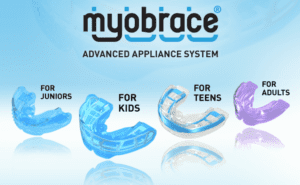
According to the Myobrace system, treatment is generally suited to children between 3 and 15 years old. The appliances are typically worn for around 1–2 hours during the day and overnight while sleeping, depending on the individual treatment plan.
The treatment focuses on habits such as:
- Mouth breathing
- Incorrect tongue resting position
- Incorrect swallowing patterns
- Poor lip posture
- Certain oral habits that may affect dental development
The goal is not simply to move teeth. Myobrace treatment aims to encourage healthier oral habits and support the natural development of the dental arches and jaws.
Why Do Children Develop Crooked Teeth?
There is rarely just one reason why a child’s teeth become crowded or misaligned.
Genetics can play an important role. Children may inherit characteristics such as:
- Smaller or narrower jaws
- Crowding
- Overbite or underbite tendencies
- Jaw shape
- Differences in tooth size
- Missing or extra teeth
- Certain patterns of dental development
At the same time, oral habits and functional factors may also be associated with certain types of malocclusion. Research has found relationships between some malocclusions and orofacial myofunctional patterns, although the exact relationship varies between conditions and the evidence is still developing.
This is why assessing a child while they are growing can be useful.
Myobrace vs Traditional Braces
Traditional braces are commonly used when a child has most or all of their permanent teeth and the teeth require orthodontic alignment.
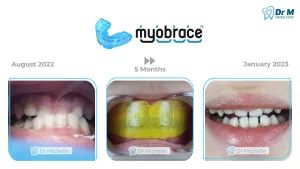
Myobrace takes a different approach. It is generally used earlier, during the developing dentition, with the aim of addressing contributing oral habits and guiding dental development.
This does not mean that every child who starts Myobrace will avoid braces completely. The Myobrace system itself notes that some children may still require braces for final alignment depending on their individual development and treatment response.
For this reason, an assessment by a dentist or orthodontic professional is important before deciding which approach is appropriate.
How Does Myobrace Treatment Work?
Myobrace treatment uses a series of removable appliances selected according to the child’s age, dental condition and treatment objectives.
The treatment may involve several stages, including:
Stage 1 – Habit Correction
The child learns healthier patterns of nasal breathing, tongue positioning, swallowing and lip posture.
Stage 2 – Arch Development
The treatment may focus on developing the dental arches and creating more suitable space for the developing teeth.
Stage 3 – Dental Alignment
As permanent teeth erupt, appliances can be used to help guide the teeth towards a more favourable position.
Stage 4 – Retention
Retention helps maintain the results achieved during treatment.
The exact number of appliances and treatment stages varies according to the individual child. Compliance is also important because Myobrace appliances are removable and need to be worn consistently.
When Can a Child Start Myobrace?
One of the key differences between early orthodontic treatment and conventional braces is timing.
Myobrace treatment can be considered from around 3 years old, depending on the child’s dental development and oral habits.
However, age alone does not determine whether Myobrace is suitable. Every child develops differently, so the dentist will need to assess:
- The child’s current teeth
- Jaw development
- Tooth crowding
- Bite relationship
- Oral habits
- Breathing and swallowing patterns
- Stage of dental development
Early assessment does not necessarily mean that treatment must begin immediately. In some children, monitoring their growth may be the most appropriate approach.
How Long Does Each Myobrace Stage Take?
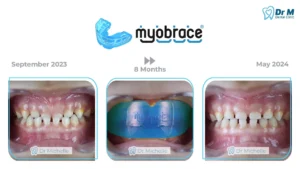
Different Myobrace series are designed for different dental conditions. Depending on the appliance and treatment plan, some treatment series involve three or four stages.
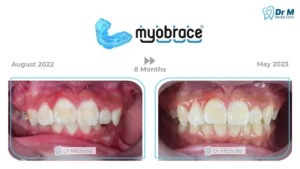
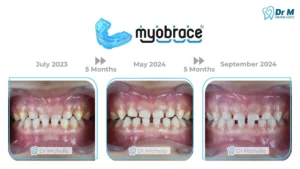
At Dr M Dental Clinic, we explain the treatment sequence based on your child’s individual condition. As a general guide, each stage may be worn for approximately 4–6 months before progressing to the next stage, although the actual timing depends on the child’s progress and compliance.
Regular dental reviews are important to determine when it is appropriate to move to the next stage.
Does Myobrace Guarantee Straight Teeth Without Braces?
No orthodontic treatment can guarantee that every child will achieve the same result.
The outcome of Myobrace treatment depends on factors such as the child’s growth, dental condition, oral habits and consistency in wearing the appliance and performing the recommended exercises.
Current research on prefabricated myofunctional appliances suggests that they can produce orthodontic changes in some children, but systematic reviews have also highlighted uncertainty in the evidence and differences in effectiveness between appliances and conditions.
Therefore, Myobrace should be viewed as an individualised early orthodontic treatment option, rather than a guaranteed replacement for braces in every child.
Is Myobrace Suitable for Your Child?
If your child has crowded teeth, an unusual bite, mouth-breathing habits or concerns about jaw development, an early dental assessment can help determine whether intervention is appropriate.
At Dr M Dental Clinic in Ipoh, our dental team can assess your child’s teeth and dental development and discuss whether Myobrace, conventional braces, monitoring or another treatment approach may be suitable.
If you are looking for a dentist in Perak for your child’s dental and orthodontic needs, early assessment can be a useful first step.
Book a consultation with Dr M Dental Clinic Ipoh to find out whether Myobrace is suitable for your child.
Dr M Dental Clinic Ipoh
Opening Hours: Every day, 9 AM – 6 PM
Including Saturdays, Sundays & Public Holidays